|
Back to Blog
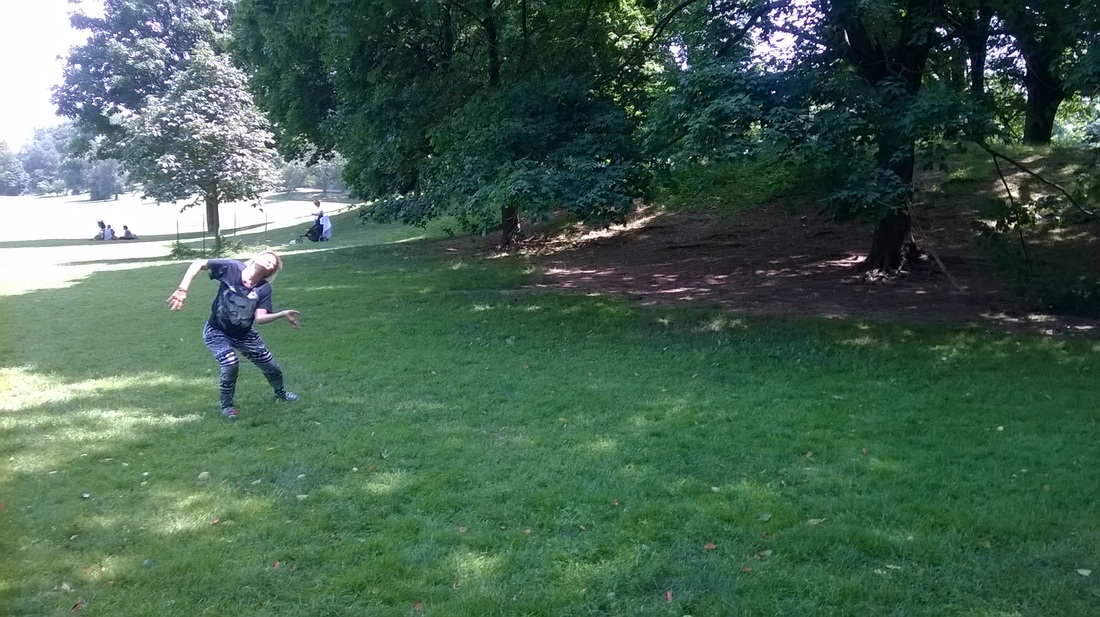
Environmental Dance ExperimentIn Aldo Leopold’s view, conservation of wildness was self-defeating. ‘When we cherish nature,’ he said, ‘we must see and fondle it, and when enough have seen and fondled, there is no wilderness left to cherish.’ Leopold contested humans should experience nature through perception and not through recreation. A photograph is one of the few hobbies in which a human can perceive nature without ‘writing one’s signature on the face of the land.’ Leopold believed in order to conserve nature we needed to establish a land ethic that focuses less on our enjoyment of nature but more on our human connection to ecology. Environmental philosopher, J.B. Callicott, furthers Leopold’s argument by advocating for a human land aesthetic that appreciates an ecosystem for its function and all of its biotic components, versus an idealized beauty that appreciates just the photo. " An autonomous natural aesthetic should involve so much more than the visual appeal of natural environments...the appreciation of an environment's natural beauty should involve the ears (the sounds of wind, insects, birds, or silence itself), the surface of the skin (the warmth of the sun, chill of the wind, textures if the grass, rock, sand etc), the nose and tongue (the fragrance of the flowers, the odor of decay, the taste of saps and waters) as well as the eyes.” J.B. Callicott from an essay titled, “The Land Aesthetic” Callicott believed in order to establish an ethical and aesthetic kinship with the land, the human relationship with nature needs to shift to support a non-anthropocentric value theory that recognizes the intrinsic values of all species to the function of the ecosystem. This shift opposes the current theory that places human as the center. Evolution is not Anthropocentric was a scientific inquiry that began with a Research Question in 2010: Can dance be a method to discover the innate human connection with the Earth, to support a non-anthropocentric dialogue of species, and to experience the land aesthetic? The Hypothesis, derived after five years of research (shorted version in the first three paragraphs) evolved to be: Yes. The role of an environmental dancer, and any environmental activist is to find a practice that habituates ‘listening’ and non-anthropocentric values. From that practice, a dance would then emerge from assessments and artistic choices with regard to eco values. The process of creating and performing Evolution is not Anthropocentric was the Experiment/Test. We began by dancing outside in five New York City sites: Prospect Park, a park alongside the Gowanus Canals, Central Park, Red Hook Recreation Area, and Rockaway Beach. The first sessions in Prospect Park began with contemplative dance practice: 20 minutes of meditation, 20 minutes of warming up the body with the eyes closed, and 20 minutes of open space (open eye) improvisation. We generated movement patterns from the last 20 minutes and shared it with each other, collaborated on more movement ideas from that place, and did some contact improvisation in the park with each other. At the Gowanus Canals the scene was industrial, confined, polluted, and noisy with planted flowerbeds, benches, and little grass. A crane was working nearby. The park, being next to a canal, a sidewalk, and a construction project, was a sharp contrast to the open and quiet space of Prospect Park. We generated movement in a similar fashion, minus the contact improvisation because of the unforgiving and rocky ground. In a Red Hook Park and Central Park we tried Authentic Movement with Nature and Contact Improvisation (CI) with nature. Authentic Movement is a movement practice in which one person moves with eyes closed, guided by internal present sensations, while the other people witness. The witness(s) watch without judgment and with a focus on inner awareness and feeling. After, they relay back the felt feelings through movement or speech. This practice encourages empathy between participants. I was interested to test if to practice authentic movement with nature could encourage understanding between other species in the respective ecosystem. We first practiced Authentic Movement together. Later we broke off and allowed nature to be our witness and we witnessed nature. In my own practice of Contact Improvisation (CI) I discovered that breath, body contact, space awareness, and a heightened sense of ‘listening’, are the values that measure the time and space between my partner and I. CI encourages non-hierarchical communication and ‘listening.’ Could CI with the ecosystem encourage an ecological practice that allows for time and space to be by the dance and discourage anthropocentric thought? Maybe. So the dancers and I first did CI with each other to practice the fundamentals and then each dancer chose partners in nature to do the same. From these experiences in the parks the dancers and I gathered data. We wrote and generated movement ideas based on sensory sensations within the environment. I asked questions and gave challenges such as; what sensations did you predominantly explore? How did the atmosphere alter or not alter your body sensations? What caused the movement to be different from before or how did you keep it the same? How did you experience contact dance with nature? After the last day of outside work at Central Park I asked, how has this process changed or not changed your daily routine in New York? Can you keep the developed relationship with nature when in the city? Out of the compiled data I began the dance making process. All of the movement performed in Evolution is not Anthropocentric came out of the nature processing. In the studio, the dancers remembered the rigidity of the rocks and the comfort of the grass, the sturdy trunk of the tree versus the lightness of the branches, the sounds of Prospect Park versus the Gowanus Canals, the smells of Central Park, the feelings of the grass on the face, and etc. After the choreography was set, but before the performance, we took the movement that we generated in the parks, and choreographed in the studio, to Rockaway beach. In the contemplative dance practice everyone ran into the waves. We danced in the ocean and on the sand and that altered some of the movement quality. One dancer asked, why did we come into the studio? She liked practicing each morning in nature. I myself questioned if we should even take the dance into the studio to create and to perform. The morning meditation and dance practice in nature influenced our New York City afternoons to be calmer. Before each studio rehearsal we did a walking meditation to remember the land on which we generated the movement. On the day of the performance, I invited audience members to join in on the guided meditation ritual with the dancers. I asked them to close their eyes and to imagine walking on soil and in a place. I titled the dance Evolution is not Anthropocentric because we cannot erase or change the present state of our ecology. Evolution has occurred since before our species existed and might occur after. I conclude that to be non-anthropocentric is to recognize that our efforts to undo that which we think we have done are anthropocentric. We cannot change evolution, we are here, we are our present ecology. Possibly we need to just remember what it is to be human in nature and then we might see the change we desire as environmentalists. Evolution is not Anthropocentric was performed on August 21, 2015 at The Woods Cooperative with dancers, Maira Duarte, Michelle Applebaum, Pavel Machuca, Miu Soda, and Joanna Stone from Dance to the People. The music was a score compiled of audio from videos taken during our outdoor exploration, a thunderstorm in Texas from my personal audio, and music by Ariel Guzik. Did the process work? I asked the audience to record their immediate thoughts on paper. After the showing we Analyzed and Drew Conclusions. The audience gave mixed reviews about whether the piece was adaptable for an indoor space. One person noted that finding a way to bring not only the movement into the studio but the sensing, feeling, and energy is parallel to bringing that into life. That is what dance artists do in essence, is to experience so that others may experience with us. One audience member asked why we started with the meditation circle with imagery of dirt/nature. ‘For the dancers,’ I said, ‘to revisit the place, to find the energy, and to find the spirit. In order to become the natural aesthetic one must find all the sensual elements from that place. And for you, the audience, to be allowed to find that too.’ Environmental dance emerged into popularity in the past decades. Had Leopold been aware of it (which I assume he was not) he might have advocated that dancing in nature was better than the photograph, when it comes to human hobbies that perceive nature. Dance is connects internal body thinking to the external. Dance is rooted in our most primitive form of understanding (the sensual). Environmental dance upholds all properties of Callicott’s natural aesthetic and reconditions picturesque and anthropocentric notions regarding natural aesthetics. Feelings and sensations are hard to keep though, and making a paradigm shift will take more than dancing in nature each day, or performing a dance about it in a closed space. Yet, it is a small, but effective entry into the labyrinth. From my field notes: We really have to reverse our thinking, and honestly, teaching the body to perceive the world differently then it has learned to do for a period of time is a task, just sitting in the park I try to envision myself as part of the pigeons world, not vice versa, as I watch them waddle throughout the tables, grabbing fries at any open moment, scuttling out of human foot traffic, I see only pigeons in a human world, flying in the human planted trees in Washington Square Park. Art, art can help change perception. But how do we keep that perception long enough to shift?
3 Comments
Read More
5/23/2025 07:34:53 am
I find this perspective of connecting to nature through all senses rather than just visual appeal very insightful.
Reply
Leave a Reply. |