|
Back to Blog
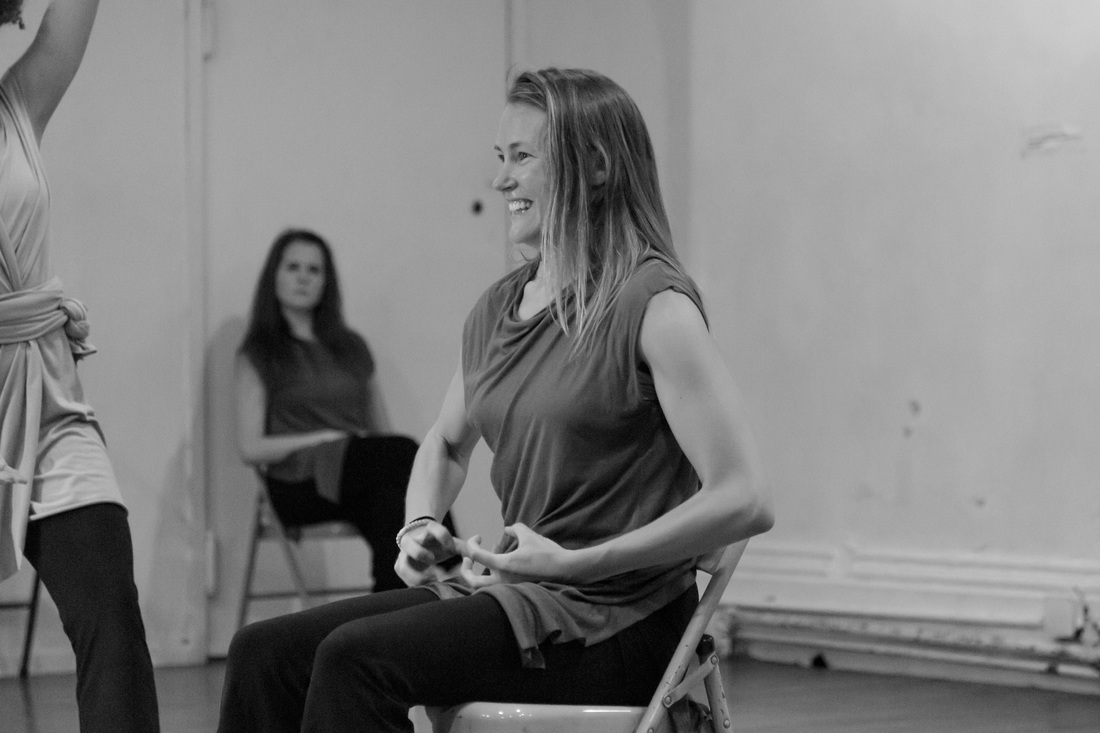
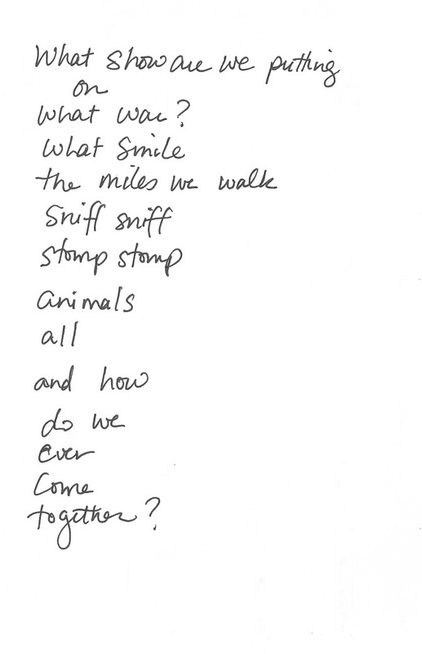
The Making of Narrentanz - Jo Stone5/28/2015 A journey into a piece of MadnessOn the first day of rehearsal when the director of Dance to the People (DTTP), Maira, said, “this dance is inspired by ideas from Foucault’s Madness and Civilization,” I knew I was in the right place. I had originally arrived at the DTTP rehearsal in January to take advantage of the free training and open collaboration opportunity. I openly admitted to Maira and the rest of the DTTP crew that I was (and am) a dancing fool. Like the character I portray in Dance to the People’s Narrentanz (Dance of Fools), whose masked smile first alludes to her normalcy, I too entered the dancing space with a façade. But just as my rapid and uncontrollable hand jitter develops in the piece and the smile graduates simultaneously into a forced grin, my attempt at deception deteriorated and I revealed my real fool by the second day of rehearsal. The other dancers reciprocated. Narrentanz formed with the support of the CUNY Dance Initiative, which gave Dance to the People a residency at the College of Staten Island. The making of the dance came from ideas of spectacle. The dance examines the discourse involved with putting on a show. Coincidentally, Foucault’s examination of the discourse associated with madness overlaps ideas of spectacle. Being mad, or a fool, wasn't always associated with medical institutionalization. Renaissance people put their mad denizens onto ships, instructing the seamen to rid the city by taking the fools out to sea. Hence where Bosch got his inspiration for Narrenschiff, the ship of fools. The spectacle of the ships, full of foreign lunatics, created great excitement for onlookers when they docked at fresh harbors. I myself had a chuckle when I looked at Bosch’s painting and thought of the boat-landing sight. Is it the familiarity with the mad that draws us to their spectacle? Is there an inner reality in folly that we possess but hide due to societal constraints? In Narrentanz the dancers play a game, each coveting the other’s chair, dressing up in clothes, and running in space. The spectacle of the game is enticing. The challenge to win brings out the madness within each player. In rehearsal for the game section I felt unrestricted, as if I was in grammar school again. The social pre-occupation attached to the folly of wanting to win that I adapted in adulthood disappeared when I got more comfortable with the other dancers/players. As we rehearsed Narrentanz, the fascination with spectacle became a fascination with the uninhibited. The challenge became to peel away the masked layers and allow something within to surface. The show that I put on when I walk through life in New York City was not the show that would attract interest. It is reported that since the Middle ages and as late as 1815, in countries such as Germany, England, and France, the custom of paying a small fee to visit mental asylums to watch the ‘show of the mad’ was one of the most popular Sunday activities for the bourgeoisie. The fact that the demand to watch the mad collects revenue in a capitalist society is intriguing. The dancers of Dance to the People, though not entirety interesting in making revenue, though needy of money to pay the bills, came together to explore movement for performance. Without preconceived intentions the dancers and collaborators brought body histories, movement language, and rehearsal dialogue together to develop this dance. They discovered that to revel the madness within was to create a spectacle. Perhaps dancers always unleash their mad for spectacle, which is why we are all crazy…or the most normal. In the Medieval times, a fool could actually get away with unorthodox words without fear of the church’s wrath. Did that make her/him mad? Or was she/he an intelligent citizen who wanted liberty so much as to put on a disguise to achieve it. After our first showing of Narrentanz, (as part of the Open Movement Series at Movement Research) DTTP Dancer, Michelle, confessed that while performing she became nervous that the audience wouldn’t relate to the body breakdown and animalistic movement. I too experienced the anxiety. I thought, “Will they think we are crazy?” The Movement Research audience wrote in response to the piece. Here is what one person had to say.
|